

TESTBERICHTEINSTITUT LLC · HOSPITAL FINANCIAL ASSISTANCE EDUCATION
Hospital Charity Care: 7 Essential Medical Debt Facts
Hospital Charity Care may provide free or discounted hospital care to people who meet a hospital’s Financial Assistance Policy requirements. If you are facing a large hospital bill, understanding the hospital’s actual policy can be an important first step.
Federal rules under Internal Revenue Code § 501(r) impose specific financial-assistance, billing and collection requirements on qualifying tax-exempt hospital organizations. Those protections are important, but Hospital Charity Care does not mean that every bill is automatically reduced or forgiven.
By Testberichteinstitut LLC · Federal information reviewed:
U.S. educational information only · Eligibility, assistance levels and state protections vary. This guide does not determine whether a particular person qualifies for financial assistance.

1. How Hospital Charity Care actually works
Hospital Charity Care generally begins with the hospital’s own written Financial Assistance Policy, often abbreviated as a FAP.
Under IRC § 501(r), qualifying tax-exempt hospital organizations that operate hospital facilities must satisfy federal requirements on a facility-by-facility basis.
One of those requirements is maintaining a written Financial Assistance Policy for each applicable hospital facility.
Eligibility
The policy must describe who can qualify for the financial assistance it offers.
Assistance
The policy must explain whether available assistance includes free care, discounted care or other levels of assistance.
Application
The policy must explain how an individual can apply for financial assistance.
Hospital Charity Care is therefore not based on one universal federal chart. One hospital may use different income, household-size, residency or documentation criteria from another hospital.
State law may also require broader Hospital Charity Care protections than the federal § 501(r) minimums.
2. A Hospital Charity Care policy must explain key terms
The IRS requires a qualifying hospital’s Financial Assistance Policy to contain several important pieces of information.
- Eligibility criteria: The policy must state the conditions a person must satisfy to receive each available level of financial assistance.
- Types of assistance: The policy must identify available discounts, free care or other assistance.
- Calculation method: The policy must explain the basis used to calculate the amount charged to a financially assisted patient.
- Application procedure: The policy must explain how to apply for Hospital Charity Care.
- Billing and collection information: Either the FAP or a separate written policy must describe actions that may be taken when a bill is not paid.
FAP-eligible patients have an additional charge protection.
Under § 501(r)(5), a qualifying hospital generally may not charge a person who is eligible under its FAP more for emergency or other medically necessary care than the Amounts Generally Billed (AGB) to people who have insurance covering that care.
For other medical care covered by the FAP, charges to a FAP-eligible person must be less than the hospital’s gross charges.
This does not mean every uninsured person automatically receives the AGB limitation. The federal limitation applies when the person is determined to be eligible under the hospital’s applicable FAP.
3. Hospital Charity Care: the 120-day and 240-day rules
Two federal time periods are frequently discussed in connection with Hospital Charity Care. They are important—but they mean different things.
A qualifying hospital facility generally must refrain from initiating specified Extraordinary Collection Actions for at least 120 days after the first post-discharge billing statement for the care.
The federal application period generally continues for at least 240 days after the hospital provides the first post-discharge billing statement.
Ordinary billing activity and many communications may continue during the application period.
The federal rules are specifically concerned with certain Extraordinary Collection Actions and with whether the hospital has made reasonable efforts to determine Hospital Charity Care eligibility.
What happens with a complete application?
If an individual submits a complete FAP application during the applicable application period, the qualifying hospital must determine whether the individual is FAP-eligible.
Specified Extraordinary Collection Actions relating to the care must be suspended while the complete application is being evaluated in accordance with the federal rules.
What happens with an incomplete application?
When an incomplete application is submitted during the application period, the hospital has specific obligations to explain what information is missing and provide a reasonable opportunity to complete the application.
The application period may also extend beyond 240 days in certain circumstances.
4. Hospital Charity Care and Extraordinary Collection Actions
Section 501(r)(6) requires qualifying hospitals to make reasonable efforts to determine whether an individual is eligible for Hospital Charity Care before taking specified Extraordinary Collection Actions, often called ECAs.
Under the IRS rules, ECAs can include certain serious collection measures.
Reporting adverse information to consumer reporting agencies can constitute an ECA.
Commencing certain civil collection actions can constitute an ECA.
Certain liens, foreclosures or seizures can qualify as ECAs.
Certain judicial collection procedures involving wages can constitute ECAs.
Not every invoice, reminder, telephone call or routine collection communication is an Extraordinary Collection Action.
Simply asking about Hospital Charity Care does not automatically prohibit all future collection activity.
5. Hospital Charity Care and FDCPA debt validation are separate protections
Hospital Charity Care rules under § 501(r) and federal debt-collection rights under the Fair Debt Collection Practices Act address different legal issues.
The FDCPA and Regulation F generally apply to a debt collector covered by federal law. They do not automatically apply in the same way to every hospital collecting its own account.
What can happen during the validation period?
If a consumer submits a written dispute within the applicable validation period, a covered debt collector generally must cease collection of the disputed debt—or the disputed portion— until it sends verification of the debt or a copy of a judgment as required by Regulation F.
This is narrower than saying: “Every call and every collection activity must immediately stop whenever any letter is sent.”
The rule depends on factors such as whether the recipient is a covered debt collector, whether the dispute was timely and whether it was submitted in the required manner.
A debt collector is not necessarily required to provide a complete medical chart, every CPT® code, a certified accounting audit or every document a consumer requests.
Verification also does not automatically erase an otherwise valid debt.
6. Hospital Charity Care and medical debt credit reporting
Medical-debt credit reporting has changed significantly over the last several years. It is important to distinguish federal law from voluntary policies adopted by nationwide consumer reporting companies.
The three nationwide credit reporting companies previously announced policies removing paid medical collections, excluding medical collections of $500 or less, and generally delaying reporting of unpaid medical collections for approximately one year.
These credit-bureau policies should not be described as a universal federal statutory “365-day medical debt shield.”
What happened to the 2025 CFPB medical-debt rule?
In January 2025, the CFPB issued a rule that would have imposed broader restrictions concerning medical debt information in credit reports and credit decisions.
On July 11, 2025, a federal district court vacated that rule. The CFPB’s current webpage expressly notes that the rule was vacated.
Accordingly, this page does not claim that a broad federal 2025 ban on medical debt credit reporting is currently in effect.
State laws may provide additional protections. Consumers should also review their actual credit reports and dispute inaccurate information where appropriate.
7. A careful Hospital Charity Care application process
A structured process can make it easier to determine whether Hospital Charity Care may be relevant to your situation.
- Identify the hospital. Confirm which hospital facility issued the bill and whether it appears to be operated by a qualifying § 501(c)(3) hospital organization.
- Obtain the current Financial Assistance Policy. Use the hospital’s official website or contact its financial-assistance or patient-financial-services department.
- Review Hospital Charity Care eligibility. Check household-income requirements, documentation rules, covered services, residency requirements and any other criteria listed in the FAP.
- Review the application instructions. Determine which form must be completed, where it should be submitted and what supporting information is requested.
- Submit a complete application where appropriate. Provide the information required by the FAP and keep a copy of everything submitted.
- Keep proof of submission. Save electronic confirmations, postal tracking, portal messages and correspondence from the hospital.
- Track the response. Record the dates of communications and whether the hospital requests additional information.
- Monitor other important notices. Do not assume that a Hospital Charity Care application automatically suspends every unrelated insurance, collection or court deadline.
I am requesting information about your current Financial Assistance Policy and Hospital Charity Care program for the hospital services associated with my account. Please provide the applicable eligibility criteria, application form, required supporting documentation and instructions for submitting a complete application. Please also let me know which department I should contact with questions concerning the application.
This example requests information. It does not state that the sender qualifies or that collection activity has automatically stopped.
Want help organizing your Hospital Charity Care questions?
The Medical Bill Review Toolkit includes editable letters, instructions, checklists and practical self-help materials for organizing your own hospital billing correspondence.
You adapt and send the materials yourself. Testberichteinstitut LLC does not decide whether you qualify for Hospital Charity Care, negotiate a hospital bill or represent you.
Purchase is optional. Financial assistance, debt reduction, settlement or any other outcome is not guaranteed.
Official Hospital Charity Care and medical debt sources
Primary federal and government consumer sources used for this educational summary. These links do not imply endorsement of Testberichteinstitut LLC.
- IRS — Financial Assistance Policies under IRC § 501(r)
- IRS — Financial Assistance & Emergency Care Policy
- IRS — Limitation on Charges under § 501(r)(5)
- IRS — Billing & Collections under § 501(r)(6)
- CFPB — Regulation F § 1006.38 Debt Disputes
- CFPB — Financial Help for Medical Bills
- CFPB — Medical Debt Collection and Credit Reporting
- CFPB — Status of the 2025 Medical Debt Regulation V Rule
Statutory Self-Advocacy & Defense Frameworks
Cross-reference our complete series of forensic medical billing guides or verify governing federal statutes directly through official government oversight portals.
Billing Dispute Hold
Freeze 30-day collection cycles immediately via written notice.
365-Day Credit Score Shield
Mandatory 1-year reporting safe harbor & $500 debt exclusion.
5-Digit CPT Code Itemization
Unbundling rights and auditing duplicate hospital markups.
FDCPA Debt Validation
Halt third-party collection agency phone calls and pressure.
240-Day Charity Care Hold
Mandatory relief protection during hardship review.
Cash Price Transparency
Benchmark gross chargemaster bills against published cash rates.
Federal No Surprises Act enforcement guidelines & Hospital Price Transparency mandates.
Consumer rights under federal debt collection statutes and FCRA medical credit reporting standards.
HIPAA 45 CFR § 164.524 statutory guidance regarding patient rights to designated billing records.
Full statutory text of 15 U.S. Code § 1692g regarding debt validation notices and consumer verification rights.

Start With the Package That Matches Your Situation
Both options include the Hospital Bill Review Toolkit, Doctor / Physician Bill Review Toolkit and U.S. Hospital List. Package 2 adds the separate Medical Debt Collection Toolkit.
Medical Bill Review Package
For hospital and doctor / physician billing.
Medical Bill Review + Collection Package
The complete package for provider billing and medical debt collection communication.
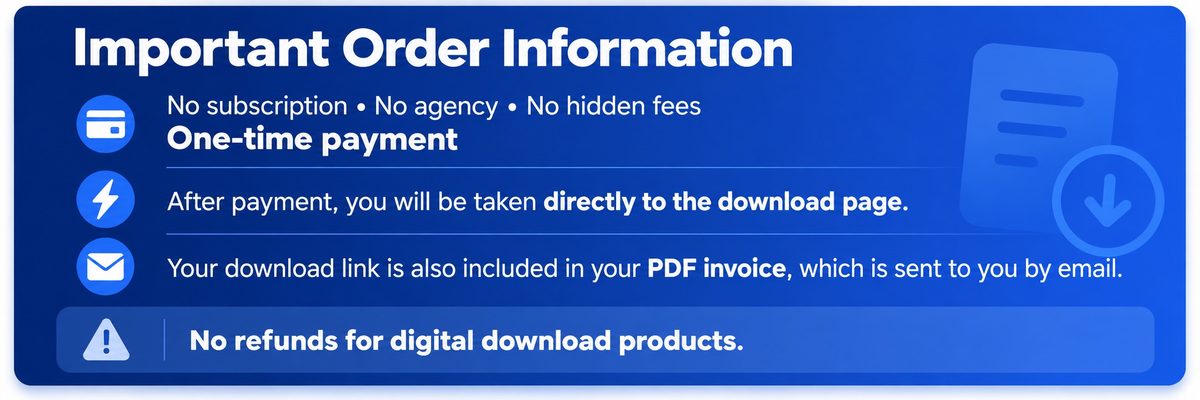
Your Files Are Available Immediately After Payment
Once your payment has been successfully completed, you will be automatically redirected to your package download page , where you can access your digital materials immediately.
Your purchased files can be accessed directly from the download page after successful payment.
Your PDF invoice is sent to you by email after purchase and also includes your package download link.